
Derek Baranowski has been a firefighter with the Burlington Fire Department for the past 25 years. For the past six years, he has been a Certified Facilitator for The Working Mind. His sessions focus on building mental health literacy and resilience through open, honest dialogue.
Building Trust Through Simplicity
Derek’s approach is straightforward. He creates a safe environment where participants feel supported.
“When you feel vulnerable, it’s not a sign of weakness,” Derek explains.
He encourages participants to rethink mental health care.
- Do you visit your doctor annually?
- Do you see a dentist regularly?
- Why not take care of your mental health the same way?
These questions push people to reconsider long-held assumptions.
Understanding Your Baseline
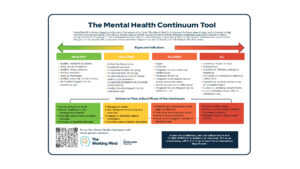
Derek highlights the importance of the Mental Health Continuum Tool. He stresses the value of recognizing your personal baseline.
“Knowing what your ‘green zone’ feels like is key,” Derek says.
This self-awareness helps people notice changes—both positive and negative—and act accordingly.
Simple Actions, Meaningful Support
Participants often feel hesitant to offer support, worried they might say the wrong thing. Derek simplifies the process.
“All you need to do is observe, provide initial support, and help connect them to resources,” he advises. “You don’t have to fix the problem.”
Derek introduces the concept of a “warm transfer.”
- Help someone find the right resource.
- Assist them in taking the next step, like making a call or setting a follow-up plan.
These small actions make a big difference.
Impact Beyond the Classroom
For Derek, the most fulfilling moments come when participants change their mindset.
“It’s rewarding to see people rethink their own biases and actions,” he reflects.
His sessions focus on more than education. They aim to transform how people think about and address mental health.
“Mental health isn’t about going it alone,” Derek reminds participants. “It’s about knowing when to reach out and how to support others when they do.”