
Business leadership has long emphasized strategy, finance, and operations. The canon is well established. Frameworks for competitive advantage, capital allocation, and organizational design remain central to how organizations operate.
What receives more attention now is how leaders build and sustain team capacity over time. Specifically, how leaders understand and support employee mental health as part of their core responsibilities.
Across Canada, organizations increasingly recognize workplace mental health as a core leadership skill. Initiatives led by the Mental Health Commission of Canada continue to push this conversation forward through training, research, and stigma reduction efforts.
How Leadership Success Is Measured
In people leadership roles, performance metrics shift.
Individual output becomes less relevant than team output. The sustainability of that output over time becomes equally important.
This means team resilience, psychological safety, and the ability to navigate pressure without burnout increasingly influence leadership effectiveness. These indicators now sit alongside traditional metrics such as quarterly targets and project delivery.
Organizations recognize an important reality. Results achieved through unsustainable pressure often carry hidden costs.
These costs include:
- Higher employee turnover
- Reduced engagement
- Declining long-term performance
Research from the World Health Organization shows mental health conditions cost the global economy billions in lost productivity each year.
Source:
This growing body of evidence continues to shape how organizations define effective leadership.
The Gap in Leadership Development
Most people leaders receive promotion based on technical excellence or individual contribution.
They demonstrate strong problem-solving ability, deadline management, and consistent quality delivery.
Leadership requires a different set of skills.
Leaders must learn to:
- notice early signs of employee struggle
- initiate supportive conversations
- create conditions where team members raise concerns without fear
These capabilities rarely appear in traditional management training programs.
Mental health training programs help fill this gap. For example, Mental Health First Aid equips individuals with practical skills to support someone experiencing a decline in mental well-being or a mental health crisis.
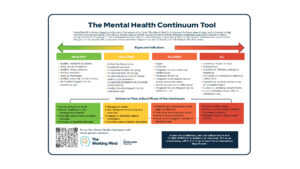
Programs such as The Working Mind help leaders recognize mental health changes and respond early before issues escalate.
These skills strengthen leadership effectiveness while supporting healthier workplaces.
From Legal Framework to Leadership Practice
Canadian employment law establishes specific obligations for employers.
The duty to accommodate requires organizations to remove barriers for employees with disabilities, including mental health conditions.
The duty to inquire means employers must initiate conversations when signs of struggle appear, even when the employee has not requested help.
These legal duties establish minimum standards. They also point toward a broader leadership competency.
Leaders must recognize when support is needed and respond appropriately.
Guidance from the Canadian Centre for Occupational Health and Safety highlights the role employers play in supporting psychological health at work.
Leaders who understand these frameworks place themselves in a stronger position to meet both legal obligations and team performance goals.
The Business Case for Integration
Organizations invest heavily in systems designed to improve productivity.
Workflow optimization. Technology upgrades. Process improvements. These investments receive regular attention and funding.
The human systems responsible for executing this work sometimes receive less structured support.
Evidence increasingly shows the importance of early mental health support in the workplace.
Research points to measurable outcomes including:
- reduced absenteeism
- lower turnover
- sustained team performance
Workplace mental health programs help organizations shift from reactive responses toward proactive leadership practices.
What This Looks Like in Practice
Supporting team mental health does not require clinical expertise. It requires practical leadership behaviours.
Effective leaders focus on four key practices.
Observation
Notice changes in behaviour, engagement, or performance patterns which signal an employee might be struggling.
Inquiry
Initiate respectful conversations based on observable facts rather than assumptions.
Flexibility
Provide reasonable accommodations such as adjusted schedules, modified duties, or environmental changes which allow employees to perform effectively.
Culture
Build team environments where mental health discussions feel acceptable and support remains normalized.
Workplace training programs such as Mental Health First Aid and The Working Mind help leaders develop these practical skills and apply them in everyday workplace situations.
The Evolving Leadership Standard
Leadership expectations change over time.
Capabilities once viewed as advanced eventually become baseline requirements.
Understanding how to support team mental health, and how to apply the duty to accommodate and duty to inquire effectively, now follows this pattern.
Mental health awareness increasingly forms part of the modern leadership standard.
For people leaders, this evolution brings clarity.
The skills which support legal compliance also strengthen team performance.
Leaders who recognize needs early, respond with flexibility, and create supportive team environments place their organizations in a stronger position to sustain long-term performance.