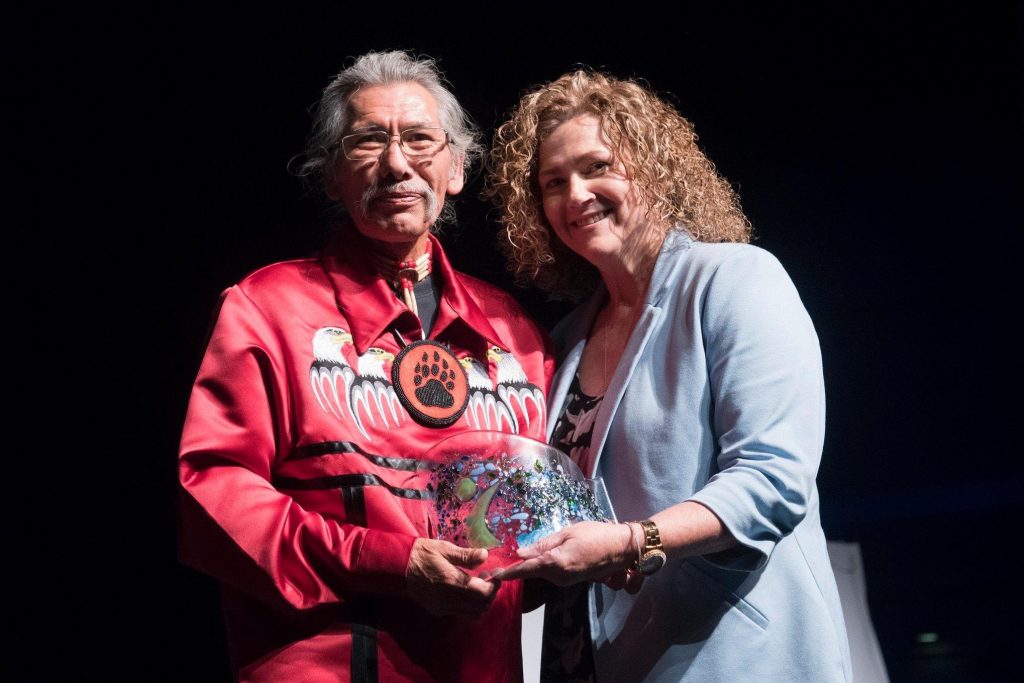
Based in Eskasoni, Cape Breton, Clark Paul first became involved with the program while working as a cultural support worker for Residential School Survivors. He recalls being asked to serve as an Elder during an early training. His response was simple: “Sure, I’ll go for it.” What began as a single opportunity grew into more than a decade of facilitating Mental Health First Aid: First Nations and supporting learners across Atlantic Canada.
Where Culture and Mental Health Meet
When Clark first became involved, he didn’t fully realize how deeply culture would shape his experience as a facilitator. “At first, I didn’t know it would come into that,” he reflects. “I did it because I was asked to do it.” It wasn’t until he began teaching that he saw the power of bringing mental health education and cultural teachings together. Looking back, he says,
“That’s when I truly started to realize how good things would go if I incorporated the two.”
That connection between mental health and culture remains at the heart of his work today. For Clark, Mental Health First Aid: First Nations is more than a course. It is an opportunity to share teachings that support both individual and community wellbeing. “What better way to bring culture to your people if it isn’t through a course like Mental Health First Aid?” he says. “It helps our way of life.”
As an Elder, Clark understands wellness as something that extends beyond the individual. This holistic view is reflected in the approach of Mental Health First Aid: First Nations, where the relationship between self, culture, community, and mental wellbeing are emphasized.
In his experience, learners leave with practical tools that help them support others when they are struggling. Rather than feeling uncertain or avoiding difficult situations, participants gain the confidence to act. As Clark puts it, “Instead of being stuck and not knowing what to do, or avoiding the people that are under the distress of mental health, you can step up and help.”
How Traditional Teachings Strengthen Learning
Part of what makes the training effective, he believes, is its accessibility. The course doesn’t rely on what Clark calls “the million-dollar words, the doctor’s words.” Instead, concepts are explained in ways that people can understand and apply in their everyday lives. The impact of that approach continues to stay with him. Recently, a nurse who had taken one of his courses stopped to thank him, sharing that it was the first training she had attended that “involved cultural teachings all the way through.”
Those teachings are not reserved for a single section of the course. They are present from the moment learners arrive. Each day begins with a smudge and prayer, as Clark explains, “to invite our spirits to help us.” At the end of the day, participants gather in a sharing circle where they are encouraged to reflect on what stood out to them, identify their “eye-openers,” and talk through any concerns or emotions that may have surfaced.
For Clark, these moments of reflection are essential. Conversations about mental health, substance use, and community challenges can be difficult, and he believes it is important that people have the opportunity to process what they have learned together. By the end of the day, he says, participants have already begun to debrief their experiences and learn from one another.
Throughout our conversation, one theme surfaced again and again: respect. Clark sees respect as the foundation for both mental wellness and healthy communities. In his view, respect starts not with others, but with ourselves. “If you’re going to have respect for someone, you have to respect yourself,” he says.
He believes Mental Health First Aid: First Nations helps learners reconnect with that understanding through culture, traditions, and self-awareness. The course, he explains, is taught “through traditions and culture” and trying to teach it any other way means “you pull away from it.” Those teachings help people better understand who they are and how they can contribute to the wellbeing of those around them.
Creating Community Change
That understanding is also what drives Clark’s vision for community change. Over the years, he has seen how small shifts in individuals can create larger shifts throughout a community. “What we try to instill in the people we teach is the fact that we, as individuals, are the ones that can make things better,” he says. Real change begins when people take responsibility for their own growth. “If you want change in your community, you have to change.” From there, the impact spreads outward. Friends notice. Families notice. Communities notice. “After a while,” Clark says, “the community changes and makes things better.”
Now, more than ten years after saying “yes” to becoming a Mental Health First Aid: First Nations facilitator, Clark continues to teach multiple courses each year. His longevity speaks not only to his dedication, but also to the ongoing need for culturally grounded mental health education in First Nations communities.
When asked what guides his work, Clark offers a teaching that captures both his role as an Elder and his approach to supporting others. Before speaking, he encourages people to ask themselves: “Is it going to hurt that person? Is it going to hurt anyone close to that person?” If the answer is yes, he says, “don’t say it.” Instead, focus on what will help.
As we celebrate Clark’s ten-year milestone as a Mental Health First Aid: First Nations facilitator, we honour the knowledge, compassion, and cultural teachings he continues to share through every course he delivers. His story reminds us that mental health support begins with understanding ourselves, supporting one another, and strengthening the communities we call home.
After a decade of facilitating, the lesson that remains at the heart of his work is both simple and profound:
“As long as you’re at peace with yourself, you’re at peace with others. It makes you a better person.”