
The right mental health training depends on the problem you need to solve. Pick the wrong program and you spend the budget without changing anything.
Workplace mental health training falls into three broad types. Each does a different job:
- Crisis response training teaches people to help someone in distress
- Stigma reduction and resilience training changes how people think and talk about mental health
- Systems training teaches leaders to manage psychological risk across the organization
Many organizations need all three. Few need them all at once.
Start with the problem
Before you compare providers, define what you want to change. Ask:
- Do employees know how to respond when a colleague is in crisis?
- Do people avoid talking about mental health at work?
- Are absence, turnover, or claims rising?
- Do you need to meet the CSA Z1003 standard or respond to an OHS concern?
Your answers point to the right type of training.
Crisis response: Mental Health First Aid
If your gap is knowing what to do in a mental health crisis, start with Mental Health First Aid.
MHFA teaches participants to recognize a decline in someone’s mental health and provide initial support until professional help is available.
The evidence base is strong. A systematic review and meta-analysis of 18 trials found MHFA training improved participants’ knowledge of mental health problems and their support for people to seek professional help, with effects lasting up to six months.
Stigma reduction: The Working Mind
If people stay silent about mental health, or managers avoid the conversation, stigma is the barrier.
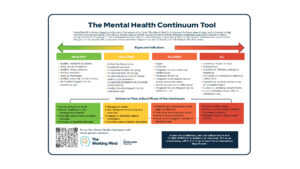
The Working Mind focuses on workplace stigma and early recognition. It introduces the mental health continuum, a shared language for describing where someone sits from healthy to ill. Separate versions serve employees and managers.
Systems change: Psychological Health and Safety
If your problems trace back to workload, leadership, or culture, individual training alone will not fix them.
Psychological Health and Safety training teaches leaders a proactive systems approach. It covers how to identify psychosocial hazards, align with the national standard, and build prevention into policies.
Five questions to ask any provider
- Is the program evidence-based? Does the provider share the research?
- Was it developed or adapted for Canadian workplaces?
- Who delivers it, and how are instructors certified?
- How will you measure results after the training?
- Does it fit into a broader mental health strategy, or does it stand alone?
A single workshop rarely changes a culture. Plan for follow-up. Our guide to rolling out training programs which last covers how.
Measure what changes
Training is an investment. Track it like one.
Set a baseline before training. Measure again at three and six months. Look at confidence, help-seeking, absence, and engagement. Our post on measuring wellness program ROI explains which metrics matter.
The Mental Health Commission of Canada has made workplace mental health a national priority. The organizations seeing results treat training as part of a system, not a one-time event.
Which problem would solve the most for your organization this year: crisis response, stigma, or systems? Start your training there.