

Stress management is not a personal skill your team should figure out alone. It is a leadership responsibility, and it starts with your weekly routine.
Statistics Canada reports 21.2% of employed Canadians rate their work-related stress at the high end of the scale. Among core-aged managers, the figure rises to 37.3%.
Stress has a cost. Workers lost an average of 2.4 days to stress or mental health absences in a single year.
This playbook gives you practical moves for 2026. Use them with your team this week.
Play 1: Find the source before you treat the symptom
Stress comes from somewhere. Heavy workload tops the list for Canadian workers, followed by work-life balance.
Ask your team directly:
- What takes more time than it should?
- Which deadlines feel unrealistic?
- What would you stop doing, given the choice?
Write the answers down. Act on at least one within two weeks. People stop sharing when nothing changes.
Play 2: Run a weekly pulse
Big annual surveys arrive too late. A short weekly check gives you early warning.
Try a two-question pulse in your team meeting:
- On a scale of 1 to 5, how manageable was your workload this week?
- What is one thing getting in your way?
Watch the trend, not the single score.
Play 3: Learn the mental health continuum
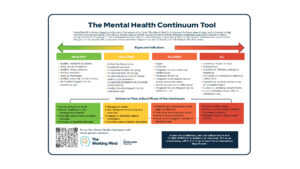
Mental health is not on or off. People move along a continuum from healthy, to reacting, to injured, to ill.
The Working Mind teaches this model. It gives you and your team a shared language for saying “I’m in the reacting zone this week” without stigma.
Early recognition matters most. Someone in the reacting zone needs a workload conversation. Someone in the ill zone needs professional support.
Play 4: Have the conversation
Many leaders avoid mental health conversations because they fear saying the wrong thing. Silence is worse.
Keep it simple:
- Name what you observed. “I noticed you’ve worked late every night this week.”
- Ask an open question. “How are things going for you?”
- Listen more than you talk
- Agree on one next step
Play 5: Know when to escalate
Some situations need more than a supportive manager. Signs of a mental health crisis require a clear response plan.
Mental Health First Aid trains you to recognize a decline in someone’s mental health, offer initial support, and guide them toward professional help.
Keep your Employee Assistance Program details easy to find. Share them before anyone needs them.
Play 6: Model the behaviour
Your team watches what you do, not what you say.
- Take your vacation
- Log off at a reasonable hour
- Talk openly about your own stress management
- Protect focus time on your calendar
The Mental Health Commission of Canada identifies leadership behaviour as a key driver of workplace mental health. Your habits set the norm.
Your playbook this week
- Ask the three workload questions in your next one-on-one
- Start a two-question weekly pulse
- Review your own working hours
- Book mental health training for yourself and your leadership team
Which of these six plays does your team need most right now?