
Toolbox talks already shape how crews think about safety. Mental health toolbox talks bring the same short, practical format to the topic most crews avoid.
Five to fifteen minutes. A small group. One clear message.
The format works for ladders and lockout. It works for mental health too.
Why Toolbox Talks Work for Mental Health
- They’re familiar. Crews already gather for them.
- They’re short. No one sits through a lecture.
- They’re regular. Repetition turns an awkward subject into a normal one.
- They’re led by people crews trust. Supervisors and peers, not outsiders.
Familiarity matters. In a 2024 Construction Safety Nova Scotia survey, half of construction workers said they don’t feel at ease talking about mental health with coworkers. Regular toolbox talks chip away at the discomfort.
Before the Talk
- Pick one topic. Stress, sleep, substance use, or how to check in on a coworker.
- Prepare the facts. Use trusted resources such as IHSA’s mental health safety talks or the CCOHS Workplace Mental Health Toolkit.
- Know your local supports. Have EAP details and the 9-8-8 crisis line ready to share.
- Plan your opening. A personal story or a real situation lands better than a statistic.
A Sample Opener
Not sure how to begin? Try something like this:
“Most of us check our gear before we start. Today, let’s check in on ourselves. Long stretches like this one wear people down. If you’ve been short on sleep, short on patience, or short on time, you’re in good company. Here’s where to get support if you need it.”
Then hand out the EAP number and open the floor.
During the Talk
- Keep it short. Ten minutes is plenty.
- Speak plainly. Use jobsite language, not clinical terms.
- Ask open questions, such as “What makes a long stretch of night shifts hard?”
- Accept silence. People need time to answer.
- Never pressure anyone to share.
- End with action. Tell people where to get help, and how to reach you.
After the Talk
- Stay available. Some workers will approach you one-on-one later.
- Act on concerns. If someone raises a workload or scheduling issue, follow up.
- Keep the rhythm. One talk a month builds more trust than a single big event.
Topic Ideas for Your Next Talks
- Spotting signs of stress in yourself and your crew
- Sleep, fatigue, and safety
- Substance use and the jobsite
- Coping after a serious incident
- Seasonal layoffs and money stress
- How to ask a coworker “Are you OK?” and what to do next
What If Someone Opens Up?
Sooner or later, a talk will lead a worker to share something serious.
- Listen without judgment
- Thank them for telling you
- Ask what support would help
- Connect them to EAP or professional help
- If you have concerns about their immediate safety, stay with them and call or text 9-8-8
Give Leaders the Skills
A toolbox talk is only as strong as the person leading it. Supervisors need the confidence to handle what comes up.
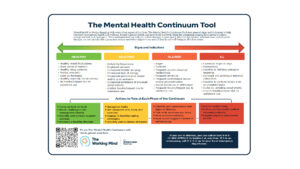
The Working Mind Trades gives supervisors the Mental Health Continuum Model, a shared language crews use in everyday conversations. Mental Health First Aid trains workers to respond when a conversation reveals someone in crisis.
Regular talks also build the speak-up culture we covered in psychological safety in construction.
Your Next Toolbox Talk
What would your crew say if you asked about mental health next week? There’s one way to find out.
Explore our mental health training for trades teams.