

Healthcare worker burnout is not a personal failing. It is a signal from the system around the worker.
Most burnout advice for health professionals points inward. Breathe deeper. Sleep more. Build resilience.
Those tools help. They do not fix a unit running three nurses short every night shift.
If you lead a hospital, clinic, or long-term care home, the question shifts. Stop asking, “How do we make staff tougher?” Start asking, “What in our workplace keeps wearing them down?”
What the Numbers Show
The data on healthcare worker burnout in Canada is hard to ignore.
- The Canadian Medical Association’s 2021 National Physician Health Survey found 53% of physicians and medical learners reported high levels of burnout.
- A 2024 Canadian Federation of Nurses Unions member survey found 94% of nurses reported some burnout, with 49% at clinical levels.
- In the same survey, 40% of nurses said they intend to leave their job, leave nursing, or retire within a year.
Burnout drives turnover. Turnover adds workload for the staff who stay. The cycle feeds itself.
Burnout Is an Occupational Problem
The World Health Organization classifies burnout as an occupational phenomenon. It defines burnout as a syndrome caused by chronic workplace stress, not successfully managed. It has three dimensions:
- Exhaustion
- Mental distance from the job, or cynicism toward it
- Reduced professional efficacy
The definition places the source in the workplace. Your response belongs there too.
Why Resilience Alone Falls Short
Resilience training teaches coping skills. Coping skills matter. Healthcare workers face grief, trauma, and moral distress as part of routine work.
Resilience has limits. Would you expect a bridge to hold forever under twice its design load? No. You reduce the load.
When organizations rely on resilience alone, three problems follow:
- Staff hear the message, “The problem is you.”
- Root causes like staffing, scheduling, and workload stay in place.
- Stigma grows, and people hide distress until they reach a crisis.
What Organizational Support Looks Like
Effective support works at the system level. Start here:
- Measure psychosocial hazards. Use a free tool like Guarding Minds @ Work to find where strain comes from.
- Fix workload and scheduling. Protect breaks. Limit back-to-back shifts. Build float pools to cover gaps.
- Train leaders. Managers shape the daily experience of work more than any policy. Equip them to spot early signs and respond with care.
- Give staff a voice. Involve frontline teams in decisions about how work gets done.
- Normalize help-seeking. Leaders who talk openly about mental health reduce stigma for everyone.
The National Standard for Psychological Health and Safety in the Workplace gives you a framework for all of this. Our Psychological Health and Safety program helps you put the standard into practice.
Where Training Fits
Training does not replace system change. It supports it.
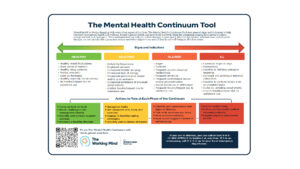
The Working Mind Healthcare helps staff and leaders understand the mental health continuum, reduce stigma, and act early. Leaders learn to support team members and manage their own stress.
Mental Health First Aid builds the skills to respond when a colleague experiences a mental health crisis.
Together, these programs give your people a shared language for mental health. They build a culture where asking for support feels normal.
Start With One Question
Ask your teams: “What makes your job harder than it needs to be?”
Listen. Act on what you hear. Report back on what changed.
Healthcare workers spend their days caring for others. Your organization’s job is to care for them. Explore our mental health training for healthcare teams.