
Generic workplace mental health training misses much of what healthcare workers face every shift. Sector-specific training closes the gap.
A course built for office workers talks about email overload and deadlines. Healthcare workers face patient deaths, violence, moral distress, and 12-hour night shifts.
Training works best when people see their own reality in it.
The Healthcare Reality
Healthcare carries its own mental health pressures:
- Exposure to trauma, death, and grief
- Moral distress when resources fall short of patient needs
- Shift work and disrupted sleep
- Workplace violence and harassment
- A culture of self-sacrifice, where asking for help feels like failure
The numbers reflect this. A Statistics Canada crowdsourced survey of health care workers found 70% reported worse mental health than before the pandemic. Among workers in direct contact with COVID-19 cases, the figure rose to 77%.
The 2021 National Physician Health Survey found 48% of physicians and medical learners screened positive for depression, up from 34% in 2017.
Why Sector-Specific Training Matters
Relevance drives engagement.
When training uses healthcare scenarios, staff connect faster. They see how each concept applies to a night shift on a medical unit, or a hard conversation with a grieving family.
Sector-specific training also:
- Speaks directly to healthcare culture, including the stigma around asking for help
- Addresses how clinical hierarchies shape help-seeking
- Uses examples from wards and clinics, not cubicles
- Prepares leaders for healthcare-specific moments, like supporting staff after a critical incident
What to Look For in a Program
Before you choose mental health training for healthcare workers, ask:
- Is it evidence-based and evaluated in Canadian healthcare settings?
- Does it include separate content for employees and for leaders?
- Does it reduce stigma, beyond raising awareness?
- Does it teach practical skills staff use on shift?
- Does it fit the scheduling realities of shift workers?
The Working Mind Healthcare
Opening Minds, established by the Mental Health Commission of Canada, delivers The Working Mind Healthcare. The program adapts The Working Mind for healthcare settings.
Participants learn to:
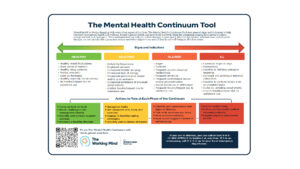
- Use the mental health continuum model to check in on themselves and others
- Recognize early signs of decline in themselves and colleagues
- Reduce stigma around mental illness
- Build coping skills for the realities of healthcare work
The Working Mind offers separate versions for employees and for managers. Managers gain skills to support their teams and respond to concerns.
Pair Training With Crisis Skills
Not every situation stays at the healthy end of the continuum. Mental Health First Aid teaches staff how to respond when a colleague experiences a mental health crisis, until professional help arrives.
Healthcare workers know first aid for patients. Few receive training to support each other.
Measure the Results
Training is an investment. Track its return.
- Run a short survey before and after training to measure shifts in stigma and confidence
- Track help-seeking, such as EAP and peer support use, over the following months
- Watch absenteeism and turnover trends on trained units
- Ask leaders which skills they use most, and where they want more support
Share the results with staff. People engage more when they see the program making a difference.
Training Works Best Inside a System
Training is one piece. For lasting change, combine it with a psychological health and safety approach addressing workload, leadership, and culture.
Ready to build a plan? See our mental health training for healthcare teams.