
Remote and hybrid work did not end the work-life balance problem. It moved the problem into your employees’ kitchens, bedrooms and phones. Here is how Canadian employers set clear boundaries, protect mental health and keep distributed teams performing.
Distributed work is here to stay. As of mid-2025, 17.4% of employed Canadians worked mostly from home, and another 10.0% split their hours between home and an outside workplace, according to Statistics Canada’s Labour Force Survey. Behind those numbers sit millions of workers whose office closes only when they decide to close it.
So who decides when the workday ends on your team? If the answer is “nobody,” you have a balance problem waiting to surface as burnout, disengagement or a disability claim.
Why Remote and Hybrid Work Strains Balance
Flexibility gives employees control over where they work. It often takes away control over when work stops. The commute once acted as a buffer between work and home. Without it, the laptop stays open and the notifications keep arriving.
Common pressure points for distributed teams include:
- Always-on expectations. Messages sent at 9 p.m. signal urgency, even when none exists.
- Blurred physical space. A dining table doubles as a desk, so the brain never fully leaves work.
- Invisible overload. Managers see output, not the hours behind it.
- Isolation. Fewer casual check-ins mean early signs of distress go unnoticed.
- Uneven hybrid days. Office days fill with meetings, and focused work spills into evenings.
The cost is real. The MHCC and Morneau Shepell workplace white paper reports 500,000 Canadians miss work each week due to mental health problems. Poor balance feeds directly into those numbers.
Know Your Legal Baseline
In Ontario, employers with 25 or more employees must have a written policy on disconnecting from work and give every employee a copy. The law defines disconnecting as not engaging in work-related emails, calls, video calls or messages outside working hours.
A policy on paper protects nobody if leaders ignore it. Treat the legal minimum as a starting line. Health and safety obligations also follow your people home. The Canadian Centre for Occupational Health and Safety advises employers to address workload, communication and isolation in any telework program, not only desks and chairs.
The CSA Z1003 standard names workload management and balance among the factors shaping psychological health and safety. Our Psychological Health and Safety training helps your leaders apply the standard to remote and hybrid settings.
Six Practices for Distributed Teams
Balance for remote and hybrid teams comes from design, not willpower. Put these practices in place:
- Set core hours. Agree on a window for live collaboration. Protect the hours outside it.
- Define response times. State which channels need a same-day reply and which wait until tomorrow.
- Use scheduled send. Leaders write messages whenever they like, then deliver them during work hours.
- Design hybrid days with intent. Reserve office days for collaboration. Keep home days for deep work.
- Make workload visible. Review capacity in one-on-ones, not only deadlines.
- Model the behaviour. When leaders log off, take vacation and skip late replies, teams follow.
Train Leaders to Spot Strain from a Distance
Distress looks different on a screen. Cameras switch off. Replies arrive at odd hours. A once-active voice goes quiet in team chats. Your managers need the skills to notice these signals and open a supportive conversation.
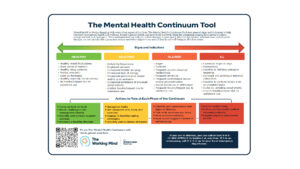
The Working Mind gives leaders and employees a shared language, the Mental Health Continuum Model, to talk about stress and recognize early changes. Mental Health First Aid builds confidence to respond when someone is struggling, whether the conversation happens in a meeting room or over video.
Psychological safety matters even more when teams rarely share a room. Google’s Project Aristotle found psychological safety was the top factor behind effective teams. On a distributed team, people need to feel safe saying, “I’m at capacity,” without fear of looking less committed.
Measure Balance, Not Only Output
What gets measured gets managed. Track a few signals each quarter:
- After-hours message volume by team
- Vacation days taken versus days available
- Pulse survey scores on workload and ability to disconnect
- Short-term disability and absence trends
- EAP use and the reasons behind it
Free tools such as Guarding Minds @ Work help you assess workload and balance as psychosocial factors and compare results over time.
Your Next Step
Start with one question for your leadership team: does our behaviour match our disconnecting policy? Audit after-hours messages for one month. Share the results. Then pick two practices from the list above and pilot them with one team.
For broader context on balance programs, read our guide to work-life balance initiatives Canadian employers are getting right. Ready to equip your leaders? Explore The Working Mind and Psychological Health and Safety training to build distributed teams where people do great work and still log off at night.